
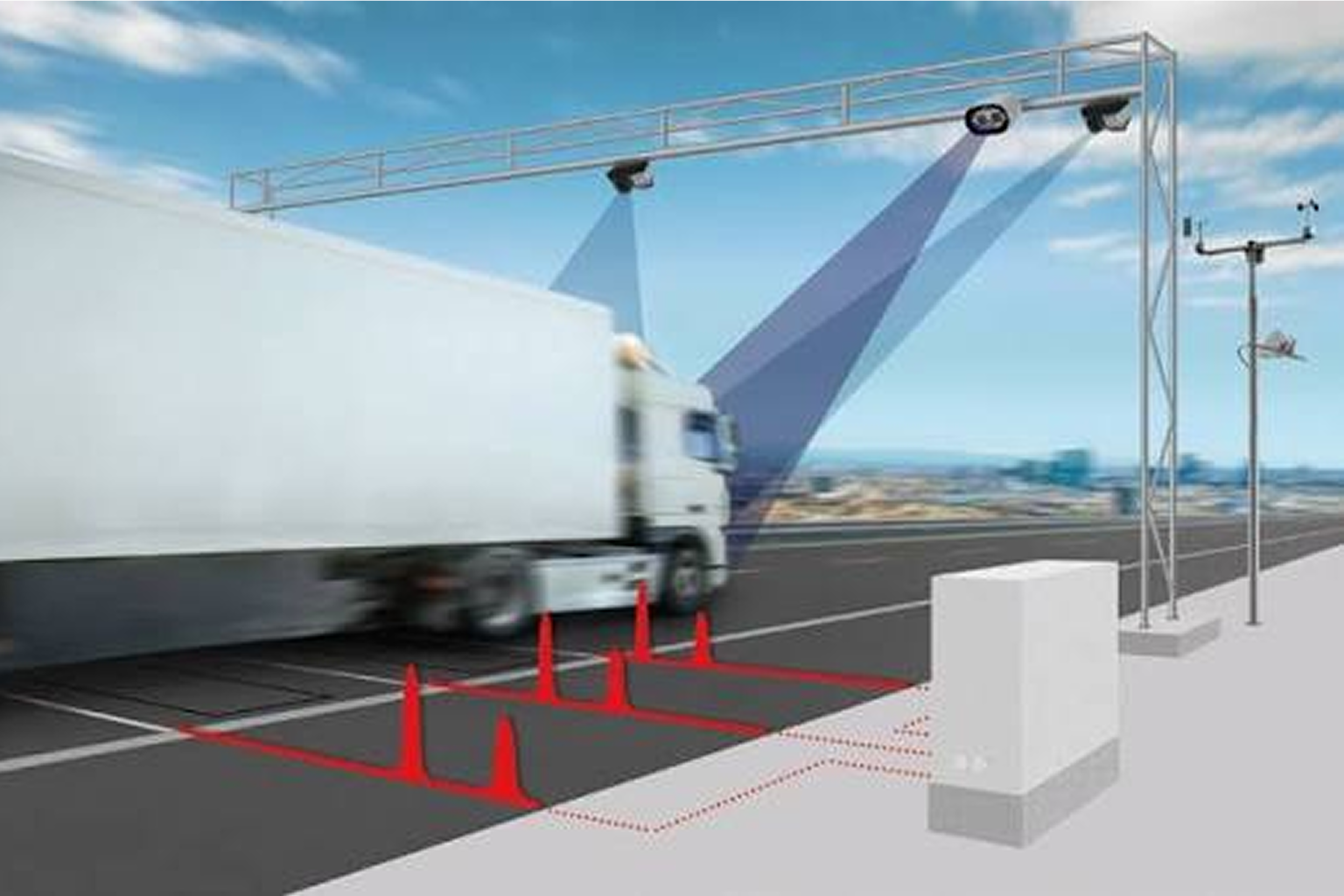
Every overloaded truck that crosses a highway, enters a checkpoint, or travels across a bridge adds stress to the road and infrastructure beneath it.
Traditional truck scales and weighbridges can measure vehicle weight accurately, but they require vehicles to stop. On busy highways and transportation corridors, that can create queues, slow freight movement, and limit how many vehicles can be screened.
Weigh-in-Motion (WIM) technology solves that problem by measuring vehicle weight while traffic remains in motion.
But WIM is not a single system. The three main configurations—High-Speed WIM (HSWIM), Slow-Speed WIM (SSWIM), and Bridge WIM (BWIM)—are designed for different speeds, locations, and operational objectives.
Understanding those differences is essential when selecting a vehicle weighing system for overload enforcement, traffic planning, checkpoints, or structural monitoring.
Heavy and overloaded vehicles can accelerate pavement deterioration and increase structural loads on bridges.
For highway authorities, logistics operators, and government agencies, this makes vehicle weight monitoring an infrastructure management issue as much as an enforcement issue.
A conventional weighbridge or truck scale works well at controlled locations, but it requires each vehicle to stop or divert through a weighing station.
WIM systems allow vehicles to remain in motion while sensors capture:
This makes Weigh-in-Motion systems particularly useful for highways, checkpoints, logistics corridors, industrial gates, and bridge monitoring applications.
High-Speed Weigh-in-Motion (HSWIM) systems are designed to weigh vehicles at normal highway speeds.
Sensors are installed in or around the roadway, allowing the system to collect weight and classification data as vehicles travel through the monitoring point without stopping.
HSWIM is commonly used for:
HSWIM can identify vehicles that appear to exceed permitted weight limits.
Instead of diverting every truck through a static weighbridge, authorities can use the system to screen traffic and direct selected vehicles for further inspection.
HSWIM also collects valuable transportation data, including:
This information can support pavement design, maintenance planning, freight studies, and infrastructure investment decisions.
For high-volume roads, HSWIM allows continuous vehicle weighing without interrupting traffic flow.
This makes it particularly useful for large transportation networks where installing traditional truck weighbridges at every location would not be practical.
Slow-Speed Weigh-in-Motion (SSWIM) is designed for controlled environments where vehicles are already moving slowly.
Typical applications include:
At lower speeds, the system can capture vehicle weight with greater stability than a full-speed highway installation.
This makes SSWIM suitable for sites that need efficient vehicle weighing but want to avoid the footprint or civil works of a traditional pit or pitless weighbridge.
A conventional truck scale requires a vehicle to stop fully for weighing.
SSWIM allows the vehicle to continue moving slowly, helping reduce processing time while maintaining controlled weighing conditions.
For sites handling frequent truck movements, this can improve throughput and reduce congestion at gates and checkpoints.
Bridge Weigh-in-Motion (BWIM) uses the bridge itself as part of the weighing system.
Instead of installing a conventional weighing platform, sensors are mounted on structural elements of the bridge.
The system estimates vehicle weight by analyzing how the bridge responds as vehicles cross it.
Measurements may include:
This makes BWIM particularly useful for bridge monitoring and infrastructure assessment.
BWIM combines two important functions:
This allows infrastructure owners to understand not only how much load is crossing the bridge, but also how the structure responds to that load.
That relationship can support:
BWIM can also complement Structural Health Monitoring (SHM) systems by linking actual vehicle loads with strain, vibration, and displacement data.
The right WIM system depends primarily on the application.
These technologies are not competing products. They solve different operational problems.
A transportation network may use all three.
WIM systems do not necessarily replace truck scales or weighbridges.
Instead, they often complement them.
For example:
This layered approach can improve traffic efficiency while maintaining accurate vehicle weight control.
The accuracy of any vehicle weighing system depends on the quality and configuration of its measurement components.
Depending on the WIM technology, these may include:
For controlled and static systems, load cells and weighing indicators play a particularly important role in converting vehicle loads into reliable weight readings.
A WIM system is only useful if its measurements remain trustworthy.
Over time, sensor performance can be affected by:
Regular verification and appropriate calibration of weighing systems help ensure that measurements remain within the required performance limits.
This is especially important when WIM data is used for:
A system that produces inaccurate data can create poor decisions even if the monitoring platform itself appears to be working correctly.
Modern WIM systems can also be integrated with broader traffic and logistics platforms.
A connected system may combine:
This allows vehicle identification, weight measurement, traffic monitoring, and enforcement data to be managed within one operational platform.
Before selecting a system, start with the operational requirement.
Ask:
The answers usually make the correct WIM configuration clear.
HSWIM is best for large-scale highway screening.
SSWIM is suited to controlled low-speed vehicle weighing.
BWIM is ideal when vehicle loads and structural bridge response need to be monitored together.
Weigh-in-Motion technology provides a practical way to measure vehicle weight without stopping traffic.
HSWIM supports high-speed screening and traffic data collection.
SSWIM provides controlled low-speed weighing for checkpoints and industrial sites.
BWIM connects vehicle weight with structural bridge response.
When combined with traditional truck scales, weighbridges, calibration, and traffic management systems, WIM can become an important part of a complete vehicle weighing and transportation infrastructure strategy.